
when i signed up for the woodturning class at the BARN, i didn’t expect to like it quite so much. i thought it would be another one of those mildly interesting weekday hobbies i’d forget about a month later, like watercolor or that time i tried to grow cooking herbs and ended up with mold in some, dryness in others, and regret at all my dead herbs. but then the instructor handed me a piece of green wood, fresh and soft, still a little damp from being part of an actual tree, and i felt the tool bite into it like butter. the shavings curled up and flew through the air, perfect little ribbons. it was instant, noisy satisfaction.
the first class met three times for three hours each, and we started with the basics: safety, stance, and the bewildering assortment of tools lined up on the wall like a family of metal wands. the roughing gouge to make square wood round. the spindle gouge for detail and curves. the parting tool for cutting to depth or separating pieces. the skew chisel, elegant and treacherous, capable of the smoothest finishes or the ugliest disasters depending on your grip.
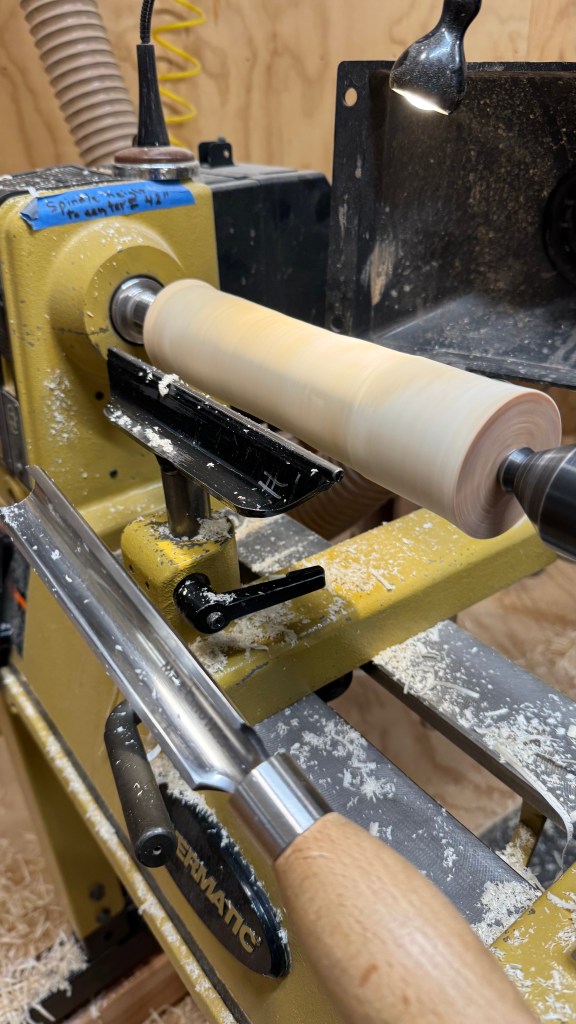
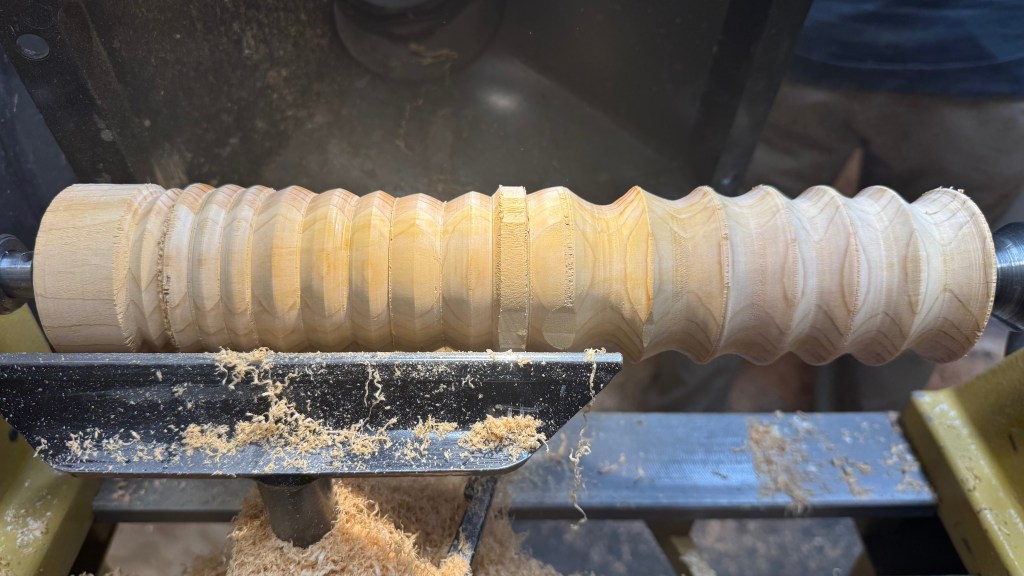
green wood, i learned, is the beginner’s friend. it forgives you. you can make all sorts of clumsy mistakes and it still gives you that satisfying, smooth cut. the first spindle i turned was just for practice, to learn how the tools felt. the second one introduced beads and valleys, those decorative bumps and dips that sound easier than they are. i spent most of one session trying to remember which wrist twist made which shape. sometimes i guessed right. other times, the wood let me know i hadn’t.
still, there was something instantly addictive about it. the rhythm of the lathe, the smell of fresh shavings, the quiet focus it demanded. i went home after the first night with sawdust in my hair and a grin on my face.

that class was taught by a woman who was kind, patient, and very good, though she talked an awful lot. she could spend fifteen minutes explaining how to hold the gouge, complete with gestures, analogies, and safety reminders, when what i really wanted was to hold the gouge and see what happened. i learned a lot, but there was more talking than turning, which left me both informed and slightly itchy to get back on the tool.
the second class was two sessions of three hours each, and this one promised more advanced techniques, making a lidded box. i didn’t know that meant i’d also be learning patience and diplomacy. the instructor, a man with strong opinions and endless commentary, hovered over my shoulder for much of the second day. when he spoke, i had to stop what i was doing to listen, and he spoke often, sometimes about what i was doing, sometimes about completely unrelated topics. i tried to stay polite, but inside i was thinking, please let me turn my box before the class ends.
still, the process itself was fascinating. we started by making what he called a dud box, using cheap wood to practice the sequence of steps before touching the good maple. that was a smart idea. the dud box came out uneven and rough, but it taught me how to approach the real one. the second day, with the maple, everything felt sharper and more deliberate.
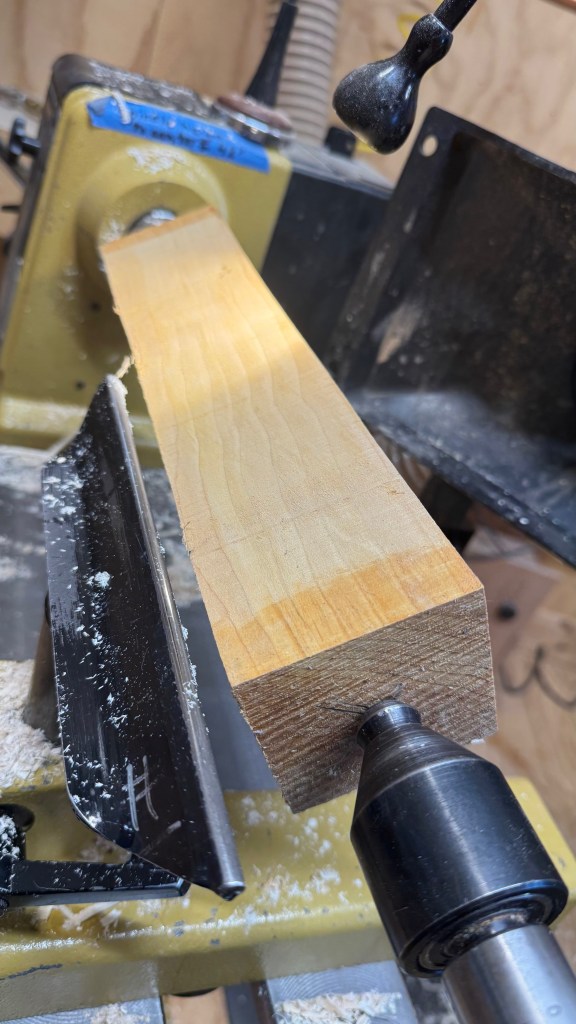

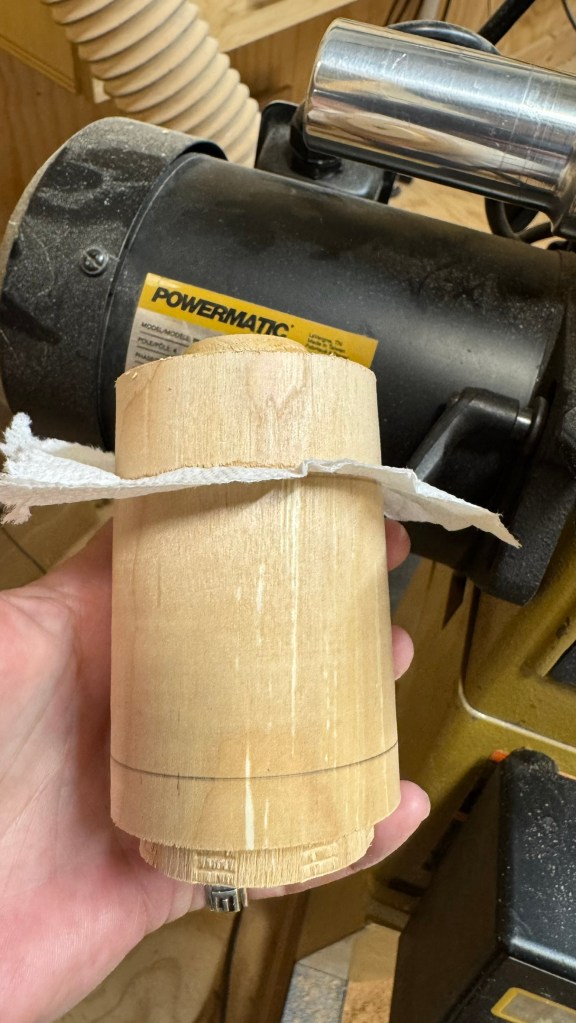
we began by shaping the lid first and hollowing it with hand tools, measuring carefully so as not to cut too deep. measuring by eye, faith, and a ruler that kept sliding under a pile of shavings, but still, measuring. then came the body, which we hollowed out with a Forstner bit before finishing the inside by hand. the idea is to use the lid as a reference for the fit, so once the lid’s inner surface is finished, you shape the top rim of the body until it slips neatly inside. then you put the lid back on and finish turning the outside of both pieces together before hollowing out the body’s interior. then you use a jam chuck to finish the bottom of the box. it sounds complicated, but it starts to make sense once you see the pieces coming together, mostly because the instructor is standing three inches away narrating your every move.
there’s a moment when you test the fit, and if you’ve done it right, there’s this small pop as the lid slides into place. it’s deeply satisfying.
my first box lid was too loose, and the instructor showed me a trick: slip a piece of paper towel between the parts to tighten the fit before finishing the outside. it worked surprisingly well. my second box lid, though, was perfect. the sides of that maple box are perfect too. every line is smooth, the grain flows neatly around the curve, and it feels right in the hand, not too heavy, not too light.
something about that second class brought out a calmer touch in me. maybe i was finally learning to trust the tool instead of wrestling it. maybe the maple was rewarding my patience. whatever it was, i made some really beautiful, smooth cuts that day, long clean passes that felt effortless. for a brief stretch of time, everything lined up, the speed, the pressure, the sound. when a cut is right, you can hear it. it sings.
the sharpening class came next, taught by the same instructor from the first class. she was as generous and thorough as ever, which is both a blessing and a time sink. there were three of us in the class, and i think she spent more time sharpening the tools than we did. we each managed to sharpen three tools in two and a half hours, which doesn’t sound like much, but sharpening is its own slow art. it’s not about how many edges you produce, it’s about learning what a sharp edge even is.
she walked us through the grinder’s rhythm: approach the wheel gently, find the bevel, hold steady, watch for sparks. every angle matters, every motion leaves a mark. when you get it right, the edge gleams like a mirror. when you don’t, it either won’t cut or it digs in like a villain. sharpening teaches humility in the same way turning does. you’re never quite done learning. it also teaches patience, because there’s no rushing someone mid-monologue when they’re explaining burr formation for the third time.
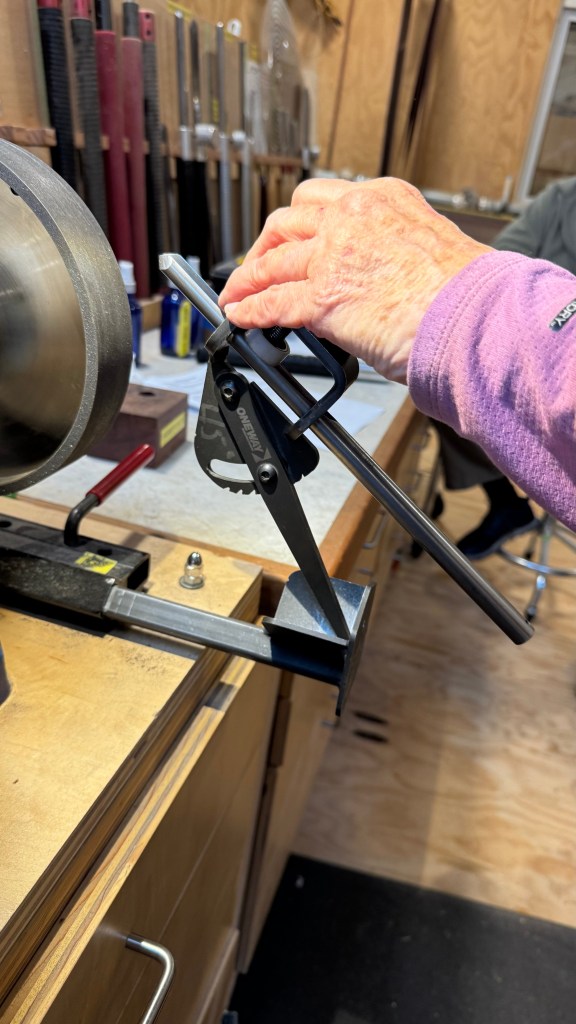
(instructor’s hand, of course…)
there’s something wonderful about how literal it all is. you can’t fake sharpness, and you can’t talk your way around it. you either did the work or you didn’t.
by the end of those classes, i’d made two spindles, two boxes, and acquired one reasonable understanding of what not to do with a parting tool. i also began eyeing the communal tools differently, grateful but ready to have my own. i’ve got a set now, tucked into a box i’ll bring to the BARN from here on out. there’s a kind of respect that comes from using your own freshly sharpened gouge, even if it’s still learning along with you.

when i got home after that last class, i took my maple box out and admired it. the lid fit beautifully, and the sides really were perfect. it was nothing anyone would ever buy or display, but it was mine, made from a piece of tree that used to sway in the wind, turned by my hands, and shaped by my stubborn learning curve. i still have to put the jam chuck on and finish the bottom, but the instructor volunteered his time to help me finish it, so i’ll take him up on that.
there’s a point in turning when the wood starts to blur, and you can’t quite see where the tool meets the surface, you just feel it. it’s a moment of trust, really. you stop measuring and start listening. you pay attention to the hum, the vibration, the sound of the cut. when it’s right, it sings a little.
that’s what keeps me coming back to the lathe, the small miracle of turning something rough into something round, one pass at a time.
and maybe what keeps me coming back to the BARN too. it’s the kind of place that hums with shared effort, half shop, half sanctuary. you can hear the clatter from the metal studio, the soft rhythm of looms, the occasional burst of laughter from the kitchen. there’s always the faint smell of sawdust in the air, like the building itself is alive and breathing through its walls. everyone’s there learning something, usually from scratch, which makes the whole place humbler than it looks. nobody’s pretending to know everything. you show up, you make a mess, you learn. and every so often, if you’re lucky, you walk out carrying something round and smooth that didn’t exist before you made it.
 catehornedotcom
Leave a comment